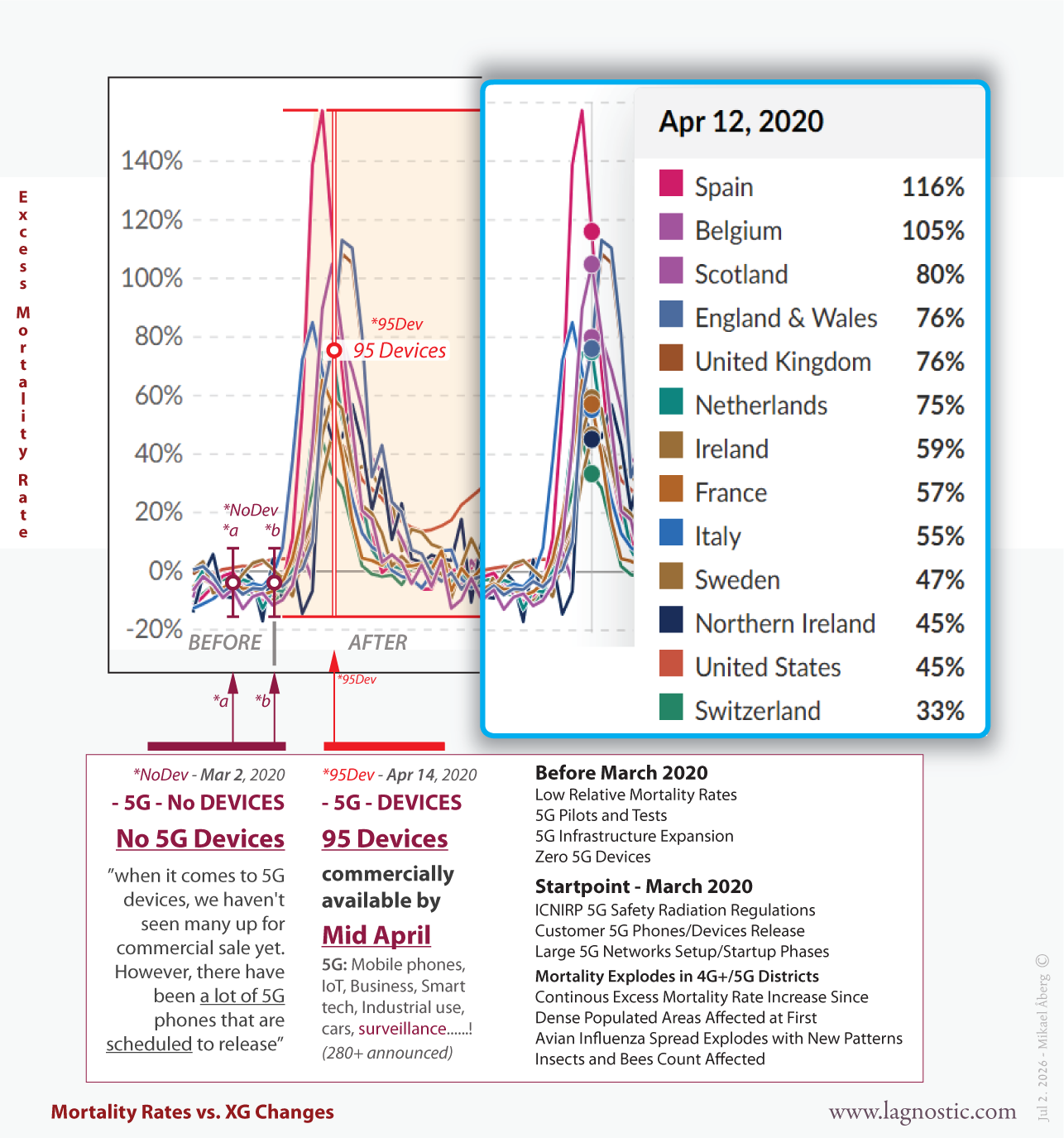
March 2020, ”Turns the Excess Mortality Rate Table” |
||||||
Excess mortality curves for a number of early adopters (Western countries) with high ambitions regarding 5G development and infrastructure [January–June 2020]. The rollout of the first 5G networks focused on densely populated and heavily visited areas [metropolitan regions, hubs], which have a significant impact on countries’ EMR rates [high peaks]. |
||||||
 |
||||||
References - - New Window (pdf)
Note: The Impact of Urban Environments on Short Wavelengths
The urban environment itself poses a challenge for the shorter wavelengths used, for example, in 5G networks; an environment composed of steel, aluminum, concrete, hard, smooth surfaces, and large moving vehicles creates reflection and interference issues, as well as radio shadow [attenuation, reflections] similar to mountainous areas where long, less interference-sensitive RF wavelengths with different polarization directions are used to bypass obstacles, corners, and peaks.
Short-wavelength bands [high frequencies] are more sensitive to variations in the refractive index of different materials [speed of light], a factor that degrades the signal’s coherence factor [phase shift, dispersion] and causes the signal [photons] to interfere with itself, thereby degrading the signal-to-noise ratio; for short wavelengths, this is a very important parameter in terms of bandwidth and potential coverage.
Factors that complicate and prolong the ramp-up phases of XG systems and the EM rate.
"Close Window"